Saint Joan


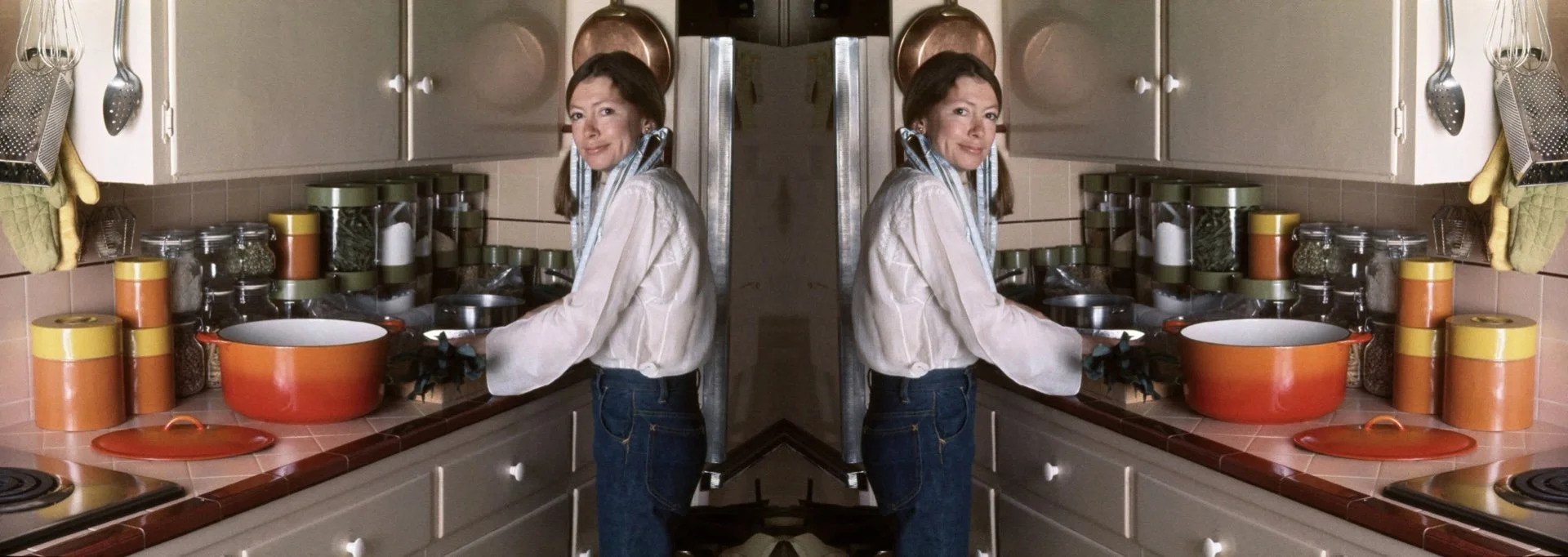
fig. a: Joan Didion’s California style

Joan Didion’s legend in the kitchen continues to grow and grow.

Stories of her legendary dinner parties have been circulating for years. And when her well-used collection of Le Creuset pots and pans went to auction a couple of years ago, less than a year after her death in December 2021, they raked in $8,000—more than 10 times their estimated value.

Recently, the New York Times bolstered the legend of Saint Joan further, with tales of her extraordinary Thanksgiving parties, where she sometimes entertained as many as 75. The article in question—“Joan Didion’s Thanksgiving: Dinner for 75, Reams of Notes”—was also notable for its attention to the Didion archives (held within the New York Public Library), and the sheer quantity of culinary material that could be found there, as well as to the centrality of the kitchen and of cooking to Didion’s philosophy of life.

Didion appears to have had something of an epiphany sometime between 1964-1965 when she was living in a furnished rental house in coastal Southern California. Many people who came to visit her there were apparently “appalled” by its condition, but the house came with a particularly well-appointed kitchen, including a six-burner stove, a pantry, and a wide variety of “extremely professional pots and pans,” and it was here that she came to the realization, “that a kitchen could be a ritual, a meditation, a room and a time of my own.” She came into her own as a cook during this period, and cooking in a well-outfitted kitchen would remain crucial to Didion’s very being for the rest of her life.

I was impressed by her elaborate dinner parties and the who’s-who of guests they attracted, of course, but I was also impressed by Didion’s earthier more matter-of-fact side, too. Didion was fastidious when it came to typing out her menus no matter how simple. One lunch menu for four from October 12, 1999 read simply: “Shrimp salad, potato chips.”

Didion, it turns out, was also a huge fan of gumbo for precisely the same reasons I’m so attracted to the dish: “I like the thrift of it, and the ritual.” Its complex flavours come from the way the dish is prepared, from the method, from the care that goes into it, as well as from the ingredients that go into it. Didion clearly understood the majesty of a true Cajun roux, insisting that it be prepared with a wooden spoon, “until the flour turns the color of a dark pecan.”
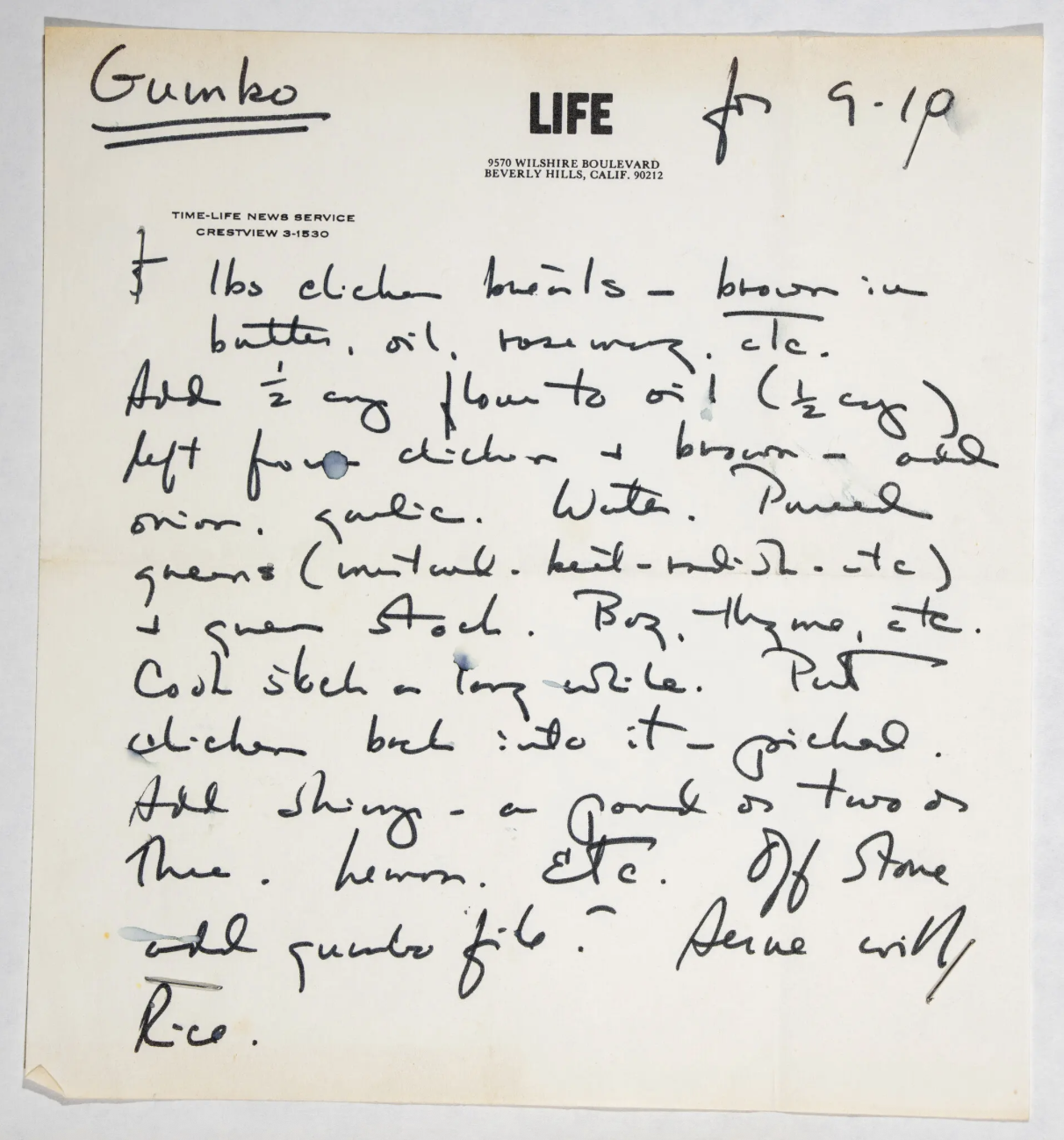
fig. b: gumbo à la Joan

Her archives contain several recipes for gumbo, and gumbo was a dish that helped her to articulate her joy of cooking: “Yesterday I made a gumbo, and remembered why I love to cook,” she noted. “Intent is everything, in cooking as in work or faith.” Yes, indeed.

Finally, here are a few tried & true AEB-approved gumbo recipes, for good measure:

Seafood gumbo, 2005

Chicken & Sausage gumbo, 2008

Turkey & Sausage gumbo, 2013

aj
Out of the Archives: "Uppuma: it's what's for breakfast." (updated edition)


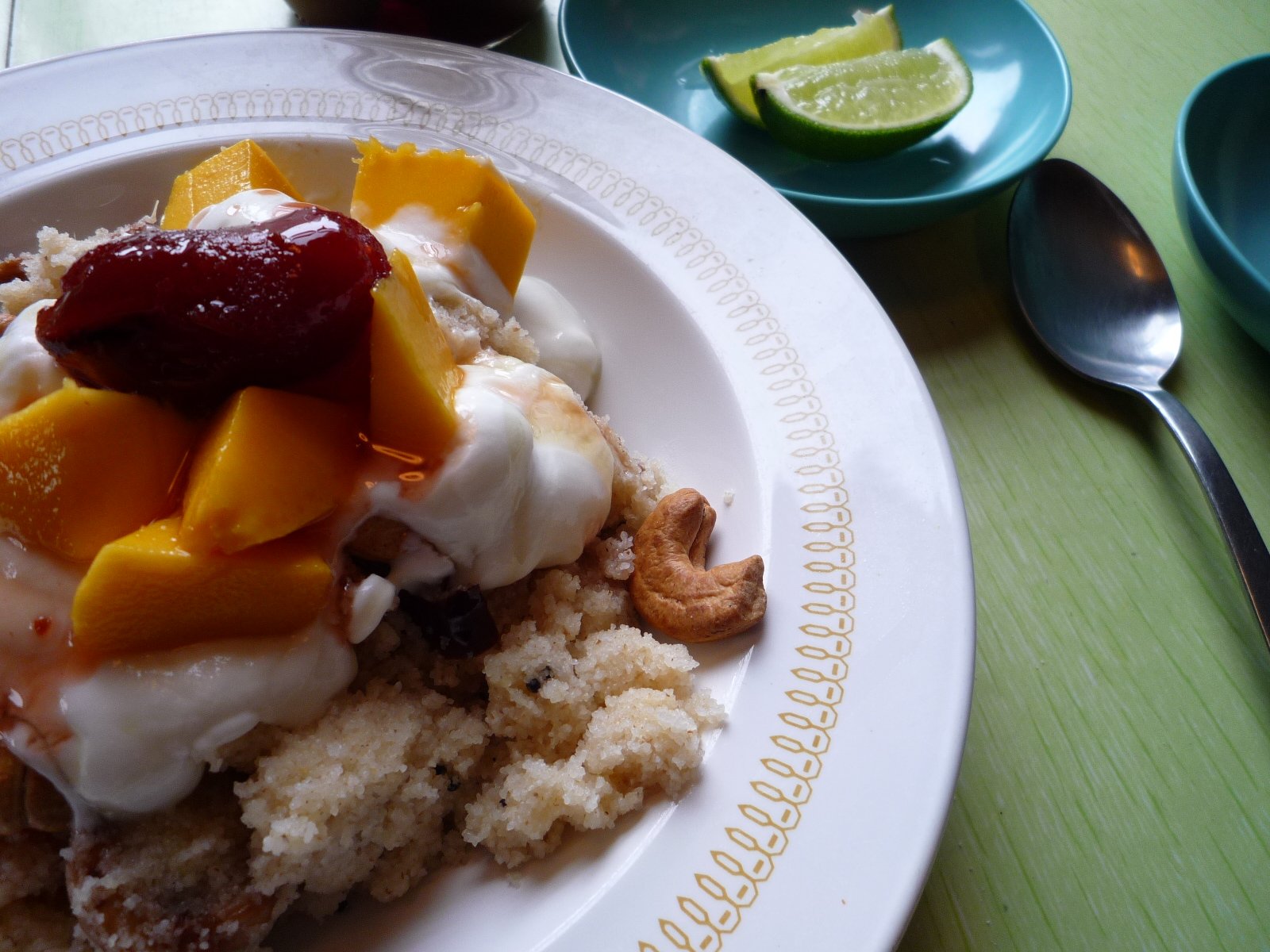
fig. a: uppuma: that was then

This post first appeared in 2009. The photograph above is how the dish in question—uppuma—was pictured at the time, in the pre-Instagram era.

This post has been updated. If you would like to see the original, you can find it here.


I first discovered uppuma sometime way back in the 1990s through my friend Carolyn. She'd gotten way deep into vegetarian Indian cuisine. Many of us admired Yamuna Devi's Lord Krishna's Cuisine: The Art of Vegetarian Indian Cuisine (1987) back then, but I'm pretty sure Carolyn was the only person I knew who owned it. And I'm positive she was the only one I knew who had the guts to actually use Yamuna Devi's Lord Krishna's Cuisine. I, on the other hand, distinctly remember looking at those long lists of ingredients and getting totally overwhelmed. I made Devi's carrot pickle once, but that was as deep as I ever got into her 800+ page tome.

Anyway, I also remember the first time I had uppuma for breakfast. Carolyn and I were visiting her parents at the beach, and she just whipped it up one morning. Just like that. I wasn't 100% sure what it was--I just knew it was South Indian and that it involved a long list of ingredients--but it was a revelation. As much as I loved spicy food at the time, I still had trouble coming to terms with spicy breakfasts--huevos rancheros and New Mexican chile verde breakfasts were about as far as I was willing to roam. Spicy/sweet breakfasts that were egg-free were the height of exotica to me.

The sad thing is, I never watched Carolyn's prep closely enough to figure out how uppuma was made, and therefore it never became a part of my repertoire. I'd think about those uppuma breakfasts longingly from time to time, but it never really went much farther than that. And within a few years I'd lost touch with Carolyn and had totally forgotten the name of her oh-so-exotic South Indian breakfast specialty.

Skip ahead about a decade. Michelle and I had just picked up a copy of Jeffrey Alford and Naomi Duguid's Mangoes & Curry Leaves (2005). The first time I leafed through it I knew--I just knew--I'd find the recipe I'd been looking for.

fig. b: Alford & Duguid’s Mangoes & Curry Leaves

Sure enough, there it was on pages 92-3--"Semolina Uppuma"*--with a nice little anecdote about Mr. Alford's affection for the dish, and the daily ritual he had while in Kerala: a swim in the ocean, a walk, and uppuma and coffee every day for breakfast.

Since getting reacquainted with uppuma,** it's become one of my favourite breakfasts, especially at this time of year—late spring—when the choice mangoes start arriving from India. There’s this magical period of time—usually no more than 4 weeks—when Alphonso and Kesar mangoes are flown in to Eastern Canada. In Montreal, there’s this whole mango underground that involves making arrangements with Indian and Sri Lankan grocers. If you get to be a part of the network, you’ll sometimes get calls late at night alerting you to the fact that a shipment has just arrived. In Ontario, you can sometimes find small cases of six mangoes at your local supermarket, especially if it’s a chain like FreshCo that frequently caters to recent immigrants. Having moved to Ontario from Montreal, the first time we did we were shocked to find what are surely among the world’s best mangoes just sitting there on display in plain sight—no waiting lists or late-night telephone assignations necessary. Anyway, I love uppuma at any time of year, but it’s a particular favourite if I can dress it with fresh Alphonso or Kesar mangoes—an already bewitching dish becomes positively intoxicating. Also, truth be told, it's not just for breakfast anymore. Uppuma can often tilt in a more savoury direction. Carolyn was fond of putting cabbage in one of her versions back in the day. I always make it this exact way—savoury/sweet and fruit-forward—but I’ve been known to have uppuma for brunch, lunch, and dinner, too—and I'm quite sure I'm not the only one.

Don’t be intimidated by the list of ingredients. Many of them are toppings, and therefore optional, and if you have the basics, uppuma is actually very easy to make. The primary ingredient, as Alford & Duguid suggest, is semolina, the same substance that's the basis of Cream of Wheat. As much as I love Cream of Wheat, uppuma is something altogether different. For one thing, you start off by dry roasting the semolina. Then you transform it into the most heady concoction of spicy and sweet. You'll never look at hot cereal the same way again. In fact, you should be forewarned: uppuma might very well change your life.

fig. c: uppuma: before

fig. d: uppuma: after (a.k.a., all-dressed)

Semolina Uppuma

2 cups coarse semolina flour (if you live in Montreal, look for "semolina #2" in local stores)
3-4 tbsp vegetable oil
1 tbsp butter or ghee (if you choose to omit this, use the extra tbsp vegetable oil listed above)
1 tsp black mustard seeds
10 roasted and lightly salted jumbo cashews, whole or coarsely chopped [Alford & Duguid’s original recipe calls for unsalted cashews, but I prefer the lightly salted, beautifully roasted ones I get from my local nut vendor]
2 dried red chilies, stemmed and coarsely chopped
pinch of asafoetida powder (optional, but highly recommended)
1 tbsp minced ginger
2-3 green chiles, such as cayenne or even jalapeño
3 cups hot water
1 tsp salt, or to taste

suggested accompaniments:
1 lime, cut into wedges
plain yogurt
1 ripe mango, preferably an Alphonso or Kesar mango from India
1 ripe banana
handful of cashews, lightly fried in a little butter, ghee, or oil until golden
candied dates and their syrup
honey

Place a skillet, preferably a wide and heavy one, over medium-high heat and add the semolina. Dry roast the semolina, stirring it frequently with a wooden spatula or spoon to prevent burning. The grains at the center, underneath, will start to turn brown first, even when it might seem as though nothing is happening yet, so every minute or so, run your spatula under the center and move the golden grains to the side to let the others take their place and become golden. After 2-3 minutes, lower the heat to medium, and continue to cook for another 4 minutes or so, until all the semolina grains are lightly touched with gold. Pour into a bowl and set aside.

Place a wide heavy pot over high heat and add the oil with the ghee or butter (if using). When the oil is hot, add the mustard seeds. Once they sputter, lower the heat to medium, add the cashews, dried chilies, and asafoetida and stir-fry briefly. Add the ginger and green chilies and stir-fry briefly, then add 3 cups of hot water.

Bring to a boil, add the salt, then add the semolina slowly in a trickle. Keep stirring with a wooden spoon as you add the grain to get it all properly mixed and to prevent lumps from forming, just as you would with porridge or polenta. Continue stirring and turning for another minute to break up lumps and moisten all the semolina. It will absorb the water quickly and if the mixture seems dry (if there are lumps of semolina that have not been fully moistened), add a little more hot water and stir. The semolina should be tender and all the water should be absorbed. Remove from heat and serve with the accompaniments of your choosing.

Our favorite combo is freshly squeezed lime juice, yogurt, fresh mango, toasted cashews, a candied date, and some of the candied date syrup.

Note: traditional uppuma recipes call for a smidgen of urad dal (Alford and Duguid's calls for 2 teaspoons), as well as some curry leaves, both of which can be hard to find if you don't live near any South Asian specialty food stores. We've found that our uppuma is still tremendously satisfying without them.

[based very closely on a recipe from Jeffrey Alford and Naomi Duguid's Mangoes and Curry Leaves]


aj

*Why "semolina uppuma"? Well, as Alford explains "uppuma" is also a term for a method of cooking involving "flavored oil and hot water."

**I've also gotten reacquainted with Carolyn, I'm happy to report, thanks to the miracle of social media.